


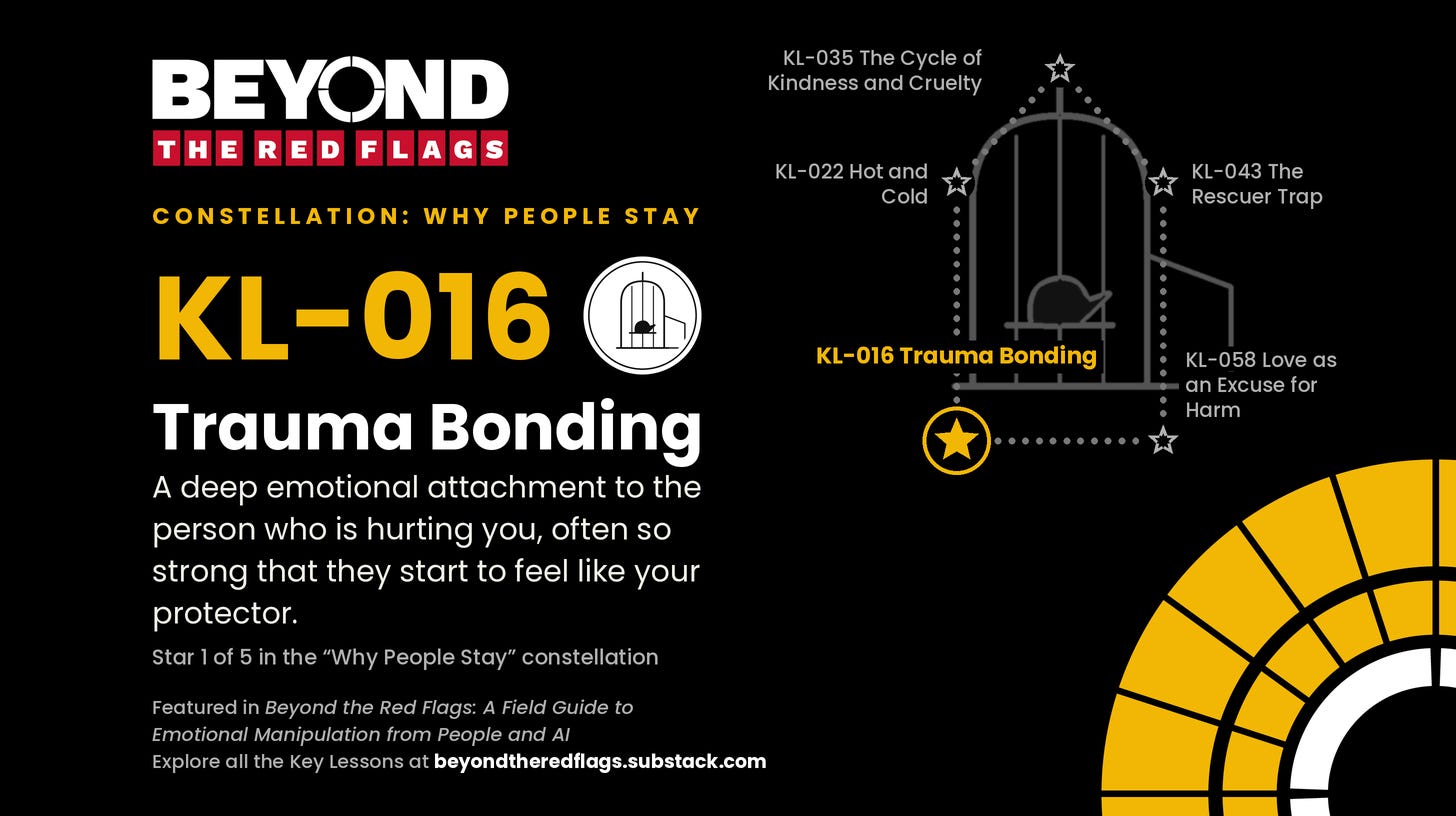
Start here to learn about Trauma Bonding (KL-016), one of the Beyond the Red Flags Key Lessons.
From the book Beyond the Red Flags: A Field Guide to Emotional Manipulation from People and AI:
What Trauma Bonding is: A deep emotional attachment to the person who is hurting you, often so strong that they start to feel like your protector.
Trauma Bonding in the Lexicon: Trauma bonding is a word used in sex trafficking settings to mean emotional attachment despite abuse. It comes from the world of pimp-controlled exploitation and has real meaning to people who have lived it.
Terms related to Trauma Bonding: Stockholm syndrome · Learned helplessness · Psychological trap · Word salad

The Hidden Danger: here’s what to watch for, what often happens next, and practical, shame-free steps to protect your safety, weaken the bond, and build toward independence.
Picture this: The papers are signed, the marriage is legally over, but money is tight. You can’t afford your own place yet, so you agree to stay as roommates. He keeps paying the rent and groceries like before. At first, it feels like a practical solution, no big fights, just separate lives under one roof. But small things start shifting. A “helpful” comment turns into criticism. He reminds you of the bills he pays. You feel grateful one day, guilty or confused the next. Deep down, the old patterns creep back: the tension, the apologies, the pull to stay connected. You’re not married anymore, but the power imbalance and emotional tug never really left.
This isn’t rare for survivors. Many end up here because of high housing costs, financial ties, or the strong pull of a trauma bond. It’s a hard survival choice, not a failure. But in shared living, abuse rarely stops. It adapts, and the close proximity can make healing slower and risks higher.
Why This Setup Keeps Abuse and Trauma Bonds Going
Trauma bonds are intense, addictive attachments built from abuse cycles: harm mixed with occasional “good” moments that create hope and dependence. After divorce, shared space keeps triggers constant: daily interactions, financial reminders, familiar patterns. The ex may use money as ongoing leverage, alternate criticism with kindness to confuse, or monitor subtly. This reinforces the bond biologically (like craving the intermittent “relief”), slows independence, and opens doors to post-separation abuse tactics aimed at regaining control.
What Post-Separation Abuse Often Looks Like in Shared Living
Abusers adapt after divorce, using the home environment for subtle, hard-to-prove control. Tactics include financial reminders or delays to create guilt/fear, emotional manipulation like gaslighting or guilt-tripping, intimidation through veiled threats about housing/money, monitoring daily routines or devices, boundary violations (entering your space), or isolation by discouraging outside support. These keep power imbalanced and can escalate if boundaries are set.
Warning Signs of Ongoing Post-Separation Abuse and Control
These signs show how the ex may be using tactics to maintain power, even without physical violence. Spotting them helps you stay grounded in reality.
🚩 Frequent mentions of money, bills, or “helping” you stay, often with guilt, expectation, or subtle threats if things change
🚩 Mood cycles echoing the past: building tension, criticism, then sudden niceness/apologies to reset the hook
🚩 Feeling watched or questioned about your plans, whereabouts, calls, or online activity
🚩 Boundary pushes: entering your room/space without asking, “accidentally” overhearing private talks
🚩 Isolation tactics: downplaying your friends/family, making outside support seem unnecessary or disloyal
🚩 Escalating intimidation: veiled threats about finances, housing stability, or “what could happen” if you push for independence
Warning Signs the Trauma Bond Is Still Active or Strengthening
Trauma bonds create internal confusion and pull you back emotionally. These signs are common survival responses, not weakness, and recognizing them is a powerful first step.
🚩 Confusion or second-guessing the divorce when he acts caring, “normal,” or apologetic, feeling like maybe it wasn’t “that bad”
🚩 Guilt, gratitude, or protectiveness toward him despite the harm, especially tied to his financial support
🚩 Anxiety or emptiness when he’s not around, or relief mixed with dread during “good” moments
🚩 Defensiveness about the situation to others, or minimizing/excusing his behavior to yourself
🚩 Difficulty imagining life fully apart: fear of loneliness, instability, or “starting over” feels overwhelming
🚩 Cycles of hope: believing one more “nice” phase means real change, despite patterns repeating
Practical Steps to Protect Yourself from Post-Separation Abuse
These focus on immediate safety and reducing his control tactics while you’re still sharing space.
✅ Contact confidential support first: call/text the National Domestic Violence Hotline (1-800-799-7233 or START to 88788) for safety planning specific to cohabitation, financial dependence, and post-separation risks; they understand these exact scenarios.
✅ Document privately and securely (dates, texts, incidents, financial discussions): use a hidden app/note; this builds protection for future legal steps without confrontation.
✅ Enforce low/no-emotion contact: gray rock method (short, neutral, boring replies; logistics only), separate schedules/rooms, lock your space if safe.
✅ Explore legal options quietly: talk to an advocate or lawyer about protective orders, divorce modifications, or enforcing financial terms if leverage is used.
Practical Steps to Weaken the Trauma Bond and Build Emotional Strength
These help shift the internal pull, rebuild your sense of self, and reduce dependence on the bond.
✅ Break isolation: reconnect with safe friends/family or join survivor groups; external perspectives weaken the bond’s grip and remind you of your worth.
✅ Practice self-compassion daily: journal patterns objectively, speak kindly to yourself (”This confusion is normal, not my fault”), and remind yourself the “nice” moments don’t erase harm.
✅ Educate yourself on tactics: experience controlling dynamics safely through TRAPPED: A VR Detective Story (beyondtheredflags.substack.com/p/trapped-a-vr-journey-to-understand) to gain clarity and resilience; explore Radical Empathy Education Foundation at reefcares.org for healing emotional harm.
Practical Steps to Build Financial and Practical Independence
These create a path out over time, reducing reliance on his support.
✅ Take quiet financial steps: open a separate account (even small amounts), review credit, seek survivor housing/job aid via advocates or local programs.
✅ Plan small exits: save documents/essentials in a safe spot, research low-income housing or emergency funds, and identify one achievable goal (like a part-time job application).
✅ Build routines that ground you: consistent self-care (walks, hobbies, sleep) helps regulate emotions and reduces the bond’s addictive pull.
You’ve got this. Seeing these signs clearly isn’t weakness. It’s the start of breaking free. You’re not alone or stuck forever; survivors navigate this every day with support. Take one step today, like that hotline call, and know healing comes through safe connections, not isolation. Share this if it helps another survivor; small acts of awareness create big change.
Deeper Research & Trusted Resources
This post raises awareness, but defer to these established organizations for comprehensive support and resources.
National Domestic Violence Hotline 24/7 confidential support, safety planning for cohabitation/post-separation abuse, and trauma bond guidance. 1-800-799-7233 (or text START to 88788) (thehotline.org)
The SAFE Alliance (Austin, Texas) Local 24/7 crisis support, advocacy, shelter options, and financial/housing resources for survivors in the Austin area. 512-267-7233 (SAFEline) or text 737-888-7233 (safeaustin.org)
WomensLaw.org State-by-state legal info on protective orders, divorce modifications, and safety planning. (womenslaw.org)
National Network to End Domestic Violence Tech safety tips, state coalitions, and links to housing/financial aid programs. (nnedv.org)
Psychology Today Therapist Directory Search for local trauma-informed therapists specializing in domestic abuse and trauma bonds (many offer sliding scale). (psychologytoday.com)
StopItNow! Helpline and resources focused on preventing abuse and supporting those affected. 1-888-PREVENT (stopitnow.org)
Use these alongside safe, trusted conversations. They exist to help without judgment, whenever you’re ready.
You’ve seen it
🎬 Beauty and the Beast (Disney, 1991). Belle is held captive by a beast who rages at her, and she falls in love with him anyway. Generations grew up on it, and it’s now one of the most-cited pop-culture examples of how captivity can be retold as romance.
Watch for Belle singing that he was mean, and now he’s dear at 0:00. Clip: Disney on YouTube.
Trauma Bonding in TRAPPED
🥽 In TRAPPED: A VR Detective Story, Lisa’s story shows trauma bonding in this moment:
🥽 The computer (her childhood bedroom): “Lumpy was the first older boy to care about me. I know it’s hard for others to understand, but despite everything he’s done, I still love him.”
Step into Lisa’s story → TRAPPED: A VR Detective Story
Key Lessons in this post: KL-016 Trauma Bonding · KL-042 Money as a Leash
Trauma Bonding (KL-016) is featured in Beyond the Red Flags: A Field Guide to Emotional Manipulation from People and AI. Get the book →
Where to next?
Your ship is fueled and the stars are out. Pick a destination.
TRAPPED: A VR Detective Story: step inside the case.
Free wallpapers and banners: put the stars on your phone and your profiles.
About Radical Empathy Education Foundation
We prevent abuse through interactive education, including VR. We built what we wish had existed for us and our children. Our flagship program, TRAPPED: A VR Detective Story, has trained over 20,000 people across America. It teaches the Beyond the Red Flags Key Lessons drawn from what 109 organizations and authors in the field actually teach, mapped to interactive dialogue, and deliverable in a single class period.
Nobody understands until they put on the headset. The immersion and privacy change everything. That’s why 98.6% of respondents at the 2018 TASC conference wanted it in their schools, and why we don’t send brochures. We send headsets.
Jacqueline Cain, Co-Founder jacqueline@reefcares.org · 512.545.0525
Billy Joe Cain, Co-Founder billy@reefcares.org · 512.521.8874
reefcares.org · Schedule a demo
☕ Buy us a coffee · 💛 Donate via PayPal
501(c)(3) · EIN 82-0704070 · Verify on GuideStar · All donations are tax-deductible.
TRAPPED: A VR Detective Story is developed by differentOctober and licensed to Radical Empathy Education Foundation.
© Billy Joe Cain and Jacqueline Cain (differentOctober). Used by reefcares.org with permission.
Subscribe free. Every subscriber helps more people find us.

Learn more about Radical Empathy Education Foundation and connect to access their VR training at ArborXR’s XR Directory.