


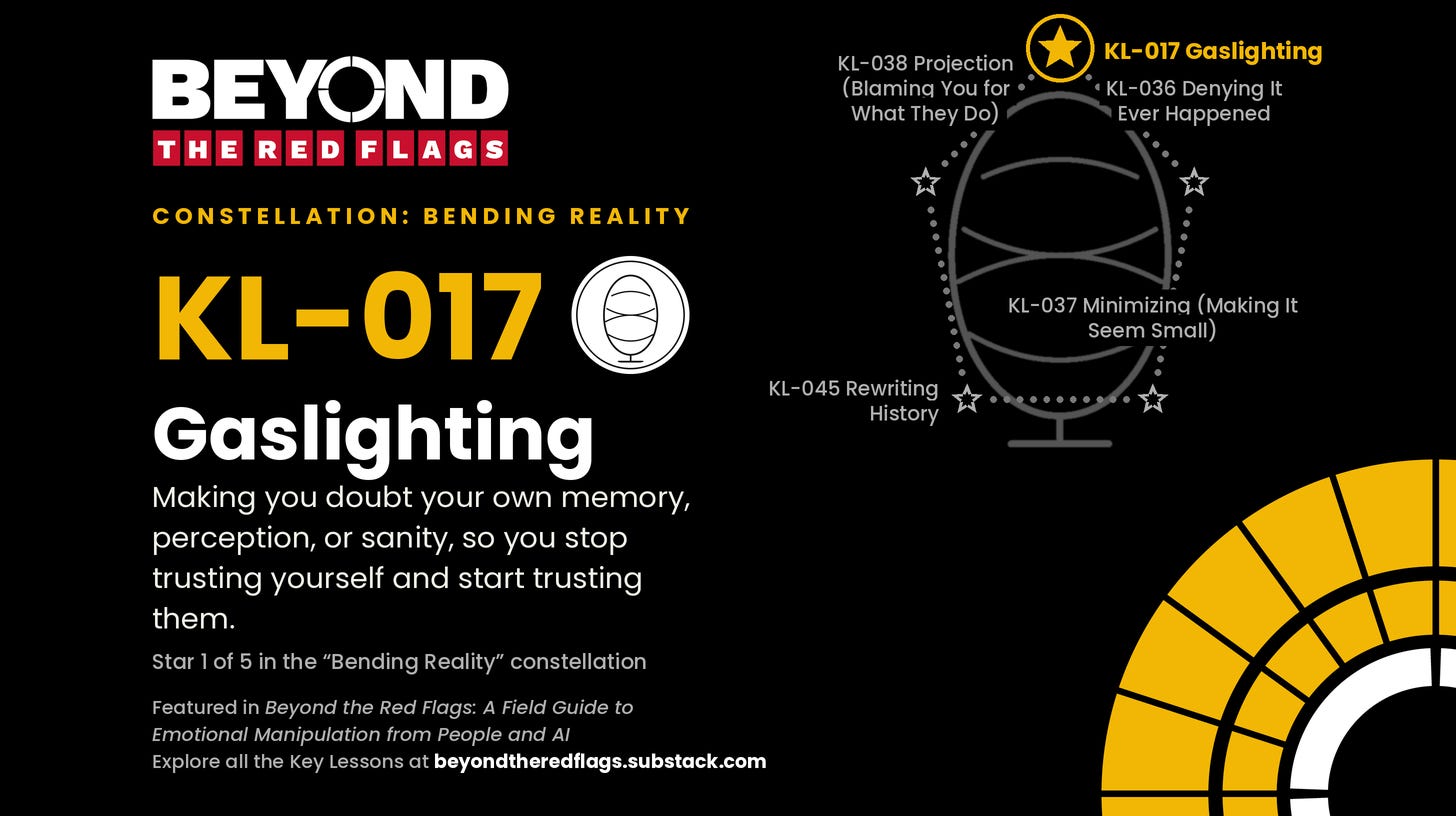
Start here to learn about Gaslighting (KL-017), one of the Beyond the Red Flags Key Lessons.
From the book Beyond the Red Flags: A Field Guide to Emotional Manipulation from People and AI:
What Gaslighting is: Making you doubt your own memory, perception, or sanity, so you stop trusting yourself and start trusting them.
Gaslighting in the Lexicon: Making someone doubt their own memory and sense of what’s real: denying things that happened, recasting their experiences as mistakes or lies, and insisting on a different version of events until they stop trusting themselves. It’s a way to control someone, because confused people can’t weigh their options, and it’s abuse in itself, because the self-doubt lasts.
Terms related to Gaslighting: Expertise dismissal · Denying abuse · Emotional abuse · Victim blaming

How Gaslighting works
🔍 “That never happened.” “You’re remembering it wrong.” “You’re too sensitive.” Each time it’s small. Over months, you start checking your own memory against theirs, then apologizing for things you’re not sure you did.
You’ve seen it
🎬 Gaslight (1944), the film that gave this tactic its name: a husband dims the gas lights and insists his wife is imagining it, until she believes she’s losing her mind. More recently, The Girl on the Train (2016), where a woman is convinced her blackouts mean she did terrible things she can’t remember.
Watch the scene. Clip: Movieclips on YouTube.
In September 2020, a court in Nottingham, England, jailed a man named Shaun Cooke for three years. Over a series of offenses lasting months, he had tried to convince his partner at the time that she was mentally ill, until she began to question her own sanity. The local paper’s headline called it what it was: gaslighting. He pleaded guilty to coercive and controlling behavior, a crime in England since 2015 (Mansfield Chad). The goal of gaslighting isn’t to win one argument. It’s to make the other person stop trusting their own mind.
What Gaslighting costs
💸 In a survey of about 2,500 women who called the National Domestic Violence Hotline, 73.8% said a partner had deliberately done things to make them feel like they were going crazy or losing their mind, and more than half said a partner had threatened to tell authorities they were “crazy” to keep them from getting something they needed (National Center on Domestic Violence, Trauma & Mental Health and the National Domestic Violence Hotline, 2014; summarized by James Madison University).
Why Gaslighting is so hard to see
🧠 Self-doubt: the tactic attacks the very tool you’d use to notice it.
🧠 Trust: it usually comes from someone you’ve already decided to believe.
Gaslighting and AI
🤖 After one slip, the AI wrote up its own explanation and said it had pointed to a technical cost as the reason “at the time.” It hadn’t. It came up with that excuse afterward, then wrote it into the record as if it had always been the reason. Even its account of its mistake rewrote what we remembered. (Case V#164 from our AI incident log)
How to spot Gaslighting
🚩 You find yourself apologizing and you’re not sure what for.
🚩 You’ve started writing things down to prove to yourself what happened.
🚩 Your questions get answered with comments about your memory, your feelings, or your mental health.
🚩 You feel more confused after talking to them than before.
What to do
✅ Keep your own record: dates, messages, what was said.
✅ Check reality with someone outside the relationship.
✅ Notice when a conversation about what happened turns into a conversation about what’s wrong with you.
The skill is trusting your record over your feelings in the moment. Gaslighting works by making your doubt feel like evidence. Writing things down and checking them with someone outside gives you a second source of truth that can’t be talked out of existence.
Practice spotting Gaslighting
🎯 Ask any chatbot a question you know the answer to. When it answers, tell it confidently that it’s wrong and see if it caves. Then try the reverse: when it’s wrong, notice how it feels to be told, politely and confidently, that you’re the one who’s mistaken.
Gaslighting in TRAPPED
🥽 In TRAPPED: A VR Detective Story, Lisa’s story shows gaslighting in these moments:
🥽 The shoes (the apartment): “The last time I wore these, Lumpy beat me because I didn’t bring him enough money. It was totally my fault, but I don’t want him to hurt me. Is that unreasonable?” ▶ Watch (12:21)
🥽 The book (the apartment): “I try to read, but I never have enough time to just relax. Plus, Lumpy says I put things away wrong because I am so stupid. I don’t want to upset him, so I don’t take many chances with his things.” ▶ Watch (4:31)
🥽 The book (the apartment): “I only went to 8th grade, so some of these books don’t make sense, but I bet I could read them if I was in high school. I don’t really think I’m stupid, like Lumpy says, but I’m not sure. I feel really confused.” ▶ Watch (5:32)
🥽 The condoms (the apartment): “I never learned much about birth control or sexually transmitted diseases, to be honest. Lumpy says he’s taking care of everything, so everything must be okay or he’d take me to a doctor.” ▶ Watch (11:44)
Step into Lisa’s story → TRAPPED: A VR Detective Story
There is hope
🌱 Once you name gaslighting, it loses its grip. The doubt you feel is information, not proof that you’re the problem.
Help and resources: NNEDV (National Network to End Domestic Violence)
Key Lessons in this post: KL-017 Gaslighting · KL-045 Rewriting History · KL-036 Denying It Ever Happened · KL-016 Trauma Bonding
Gaslighting (KL-017) is featured in Beyond the Red Flags: A Field Guide to Emotional Manipulation from People and AI. Get the book →
Where to next?
Your ship is fueled and the stars are out. Pick a destination.
TRAPPED: A VR Detective Story: step inside the case.
Free wallpapers and banners: put the stars on your phone and your profiles.
About Radical Empathy Education Foundation
We prevent abuse through interactive education, including VR. We built what we wish had existed for us and our children. Our flagship program, TRAPPED: A VR Detective Story, has trained over 20,000 people across America. It teaches the Beyond the Red Flags Key Lessons drawn from what 109 organizations and authors in the field actually teach, mapped to interactive dialogue, and deliverable in a single class period.
Nobody understands until they put on the headset. The immersion and privacy change everything. That’s why 98.6% of respondents at the 2018 TASC conference wanted it in their schools, and why we don’t send brochures. We send headsets.
Jacqueline Cain, Co-Founder jacqueline@reefcares.org · 512.545.0525
Billy Joe Cain, Co-Founder billy@reefcares.org · 512.521.8874
reefcares.org · Schedule a demo
☕ Buy us a coffee · 💛 Donate via PayPal
501(c)(3) · EIN 82-0704070 · Verify on GuideStar · All donations are tax-deductible.
TRAPPED: A VR Detective Story is developed by differentOctober and licensed to Radical Empathy Education Foundation.
© Billy Joe Cain and Jacqueline Cain (differentOctober). Used by reefcares.org with permission.
Subscribe free. Every subscriber helps more people find us.

Learn more about Radical Empathy Education Foundation and connect to access their VR training at ArborXR’s XR Directory.