


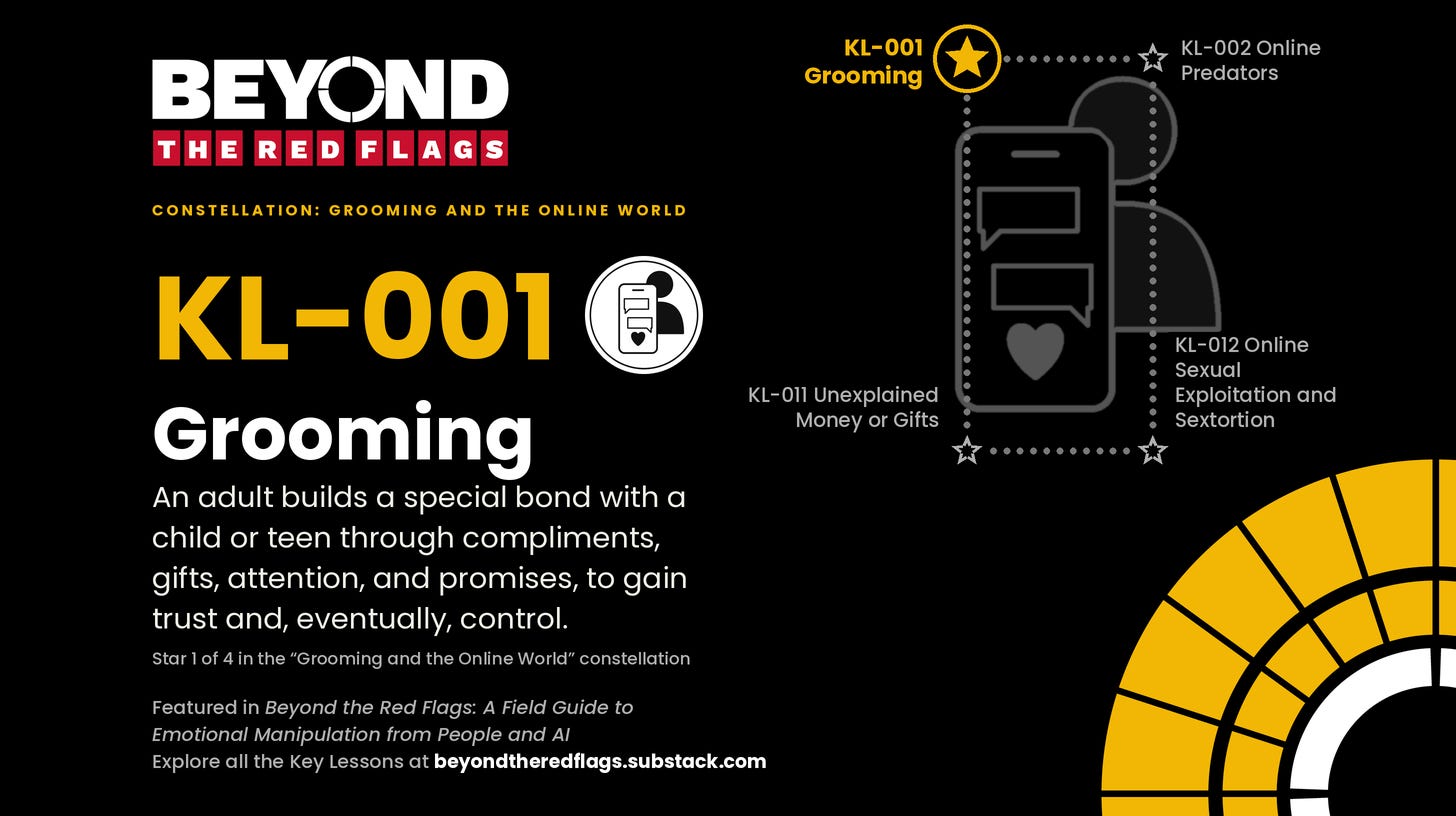
Start here to learn about Grooming (KL-001), one of the Beyond the Red Flags Key Lessons.
From the book Beyond the Red Flags: A Field Guide to Emotional Manipulation from People and AI:
What Grooming is: An adult builds a special bond with a child or teen through compliments, gifts, attention, and promises, to gain trust and, eventually, control.
Grooming in the Lexicon: Grooming is the process by which a perpetrator gradually builds trust, emotional dependency, and normalized boundary violations with a potential victim, over days, weeks, or months, in order to facilitate eventual exploitation. Grooming may involve the careful meeting of the victim’s emotional and material needs, the incremental introduction of increasingly inappropriate content or behavior, the systematic isolation from protective relationships, and the cultivation of shame and secrecy that prevent disclosure.
Terms related to Grooming: Trust exploitation · Emotional exploitation · Shaming

Grooming looks like kindness
Grooming works because it looks like kindness. The groomer becomes the fun adult, the one who listens, the one who gives. By the time anything is clearly wrong, the child feels too close, too special, or too ashamed to tell.
That’s what makes grooming so dangerous: every single step, on its own, can look like a good thing.
You’ve seen it
🎬 In Abducted in Plain Sight (Netflix, 2017), a charming neighbor groomed not just a 12-year-old girl but her entire family, becoming so trusted that her parents missed every warning sign, and she was kidnapped twice.
Jerry Sandusky was a celebrated Penn State football coach who, in 1977, founded The Second Mile, a charity for underprivileged and at-risk boys. That charity is where he met the boys he abused. With one boy, he spent more and more time, took him to sporting events, and gave him gifts. In 2012, he was convicted on 45 counts of child sexual abuse and sentenced to 30 to 60 years in prison.
The person grooming a child can be the one everyone trusts most.
Why Grooming is so hard to see
🧠 Two things work against parents and caring adults. The first is trust: groomers are often people the family already likes. The second is that grooming looks like kindness: attention and gifts are usually good things.
In Thorn’s national research on young people, 1 in 6 sextortion victims were 12 or younger when it first happened, and for many kids, chatting and flirting with adults they’d met online had come to seem normal. That sense of normal is what grooming builds.
How AI is changing Grooming
🤖 Predators now use AI to write messages in a teen’s own slang, generate fake profile photos, and keep dozens of grooming conversations going at once. The patience and attention that once took one predator months can now be scaled.
How to spot Grooming
🚩 An adult pays special attention to one child, with gifts, favors, or one-on-one time.
🚩 The relationship includes secrets, or the adult discourages the child from telling parents.
🚩 The adult tests small boundaries, then bigger ones.
🚩 The adult works to win the parents’ trust, too.
The skill is watching patterns, not single moments. Any one gift or compliment means little. A pattern of special attention, secrecy, and boundary testing means a great deal.
What to do
✅ Know the adults in your child’s life, online and off, and pay attention to any relationship built on secrets.
✅ Teach the difference between surprises, which get shared, and secrets, which hurt.
✅ If you’re concerned, trust your instinct and report it. You don’t need proof to ask for help.
Grooming in TRAPPED
🥽 In TRAPPED: A VR Detective Story, Lisa’s story shows grooming in these moments:
🥽 The shoes (the apartment): “Lumpy gave me these really expensive shoes on our one-month anniversary. They are really pretty shoes, but they have some bad memories.” ▶ Watch (9:54)
🥽 The shoes (the apartment): “Lumpy shows me that he loves me by getting me nice presents when I do what he wants. He says that once he makes enough money, we’ll move away together, but it’s taking longer than he wants.” ▶ Watch (10:05)
🥽 The lipstick (the apartment): “Mama never let me wear lipstick. She said I was too young. I thought makeup would make me pretty. Now, I don’t know what to think. Lumpy makes me have sex with strangers for money. He teaches me what I have to do, how to make myself look older or younger, and how to talk to men to bring him more money. Keeping my makeup tight is really important if I want to bring back enough cash.” ▶ Watch (8:36)
🥽 The lipstick (the apartment): “This is Lumpy’s favorite color. He says it ‘makes me look 18,’ which makes men think I want to be paid to have sex for some reason. I hate it, but I have to help Lumpy make money if we are ever going to move away together. He says he almost has enough, so I am going to try harder.” ▶ Watch (9:27)
🥽 The teddy bear (the apartment): “Now that I think of it, this all started when I first met Lumpy online and he talked me into sneaking out of the house. When I met him at his car, he gave me a cute teddy bear.” ▶ Watch (15:02)
🥽 The computer (her childhood bedroom): “Lumpy became my boyfriend after we’d met online about a year ago. Sneaking to go out with him felt so fun and risky. He would take me to watch the planes take off and land at the airport at night. We would park near the landing strip so we could be near the planes. Those were good times.” ▶ Watch (16:16)
🥽 The computer (her childhood bedroom): “Lumpy found me online when I was feeling down about myself. He was so nice to me and he would give me really expensive gifts. Things I could never afford. It made me feel really special.” ▶ Watch (16:33)
🥽 The computer (her childhood bedroom): “Lumpy was the first older boy to care about me. I know it’s hard for others to understand, but despite everything he’s done, I still love him.” ▶ Watch (17:07)
🥽 The bedroom window (her childhood bedroom): “My mother hated when I snuck out. Whenever I came home, she’d scream at me for hours. When I told Lumpy about it, he told me ‘baby, it’s just you and me against the world’. And I believed him.” ▶ Watch (17:36)
🥽 The teddy bear (her childhood bedroom): “Lumpy gave me this bear on our first date. I ran away with Lumpy soon after we met. He gave me attention, took me to sit-down restaurants, bought me flowers, clothes, shoes, whatever. I was thirteen years old and everything was beautiful. Then he asked me to have sex with one of his friends. I said ‘no’, but he got really angry, so I did it. Now he makes me have sex for money all the time. He says we’ll run away together once he has enough money, so I guess it’s okay because it’s our future.” ▶ Watch (20:38)
Step into Lisa’s story → TRAPPED: A VR Detective Story
A shared international term
Grooming is a shared international term, defined in the Luxembourg Guidelines, the terminology guidelines for the protection of children from sexual exploitation and sexual abuse. Using the same words as the global child-protection field helps everyone recognize the same pattern. Read them at ecpat.org/luxembourg-guidelines.
There is hope
🌱 Grooming depends on adults not noticing. Every adult who learns the pattern becomes one more person a groomer can’t get past.
Help and resources: Darkness to Light (d2l.org)
Key Lessons in this post: KL-001 Grooming · KL-002 Online Predators · KL-018 Love Bombing · KL-046 Encouraging Secrecy · KL-050 Gradual Escalation · KL-012 Online Sexual Exploitation and Sextortion
Grooming (KL-001) is featured in Beyond the Red Flags: A Field Guide to Emotional Manipulation from People and AI. Get the book →
Where to next?
Your ship is fueled and the stars are out. Pick a destination.
TRAPPED: A VR Detective Story: step inside the case.
Free wallpapers and banners: put the stars on your phone and your profiles.
About Radical Empathy Education Foundation
We prevent abuse through interactive education, including VR. We built what we wish had existed for us and our children. Our flagship program, TRAPPED: A VR Detective Story, has trained over 20,000 people across America. It teaches the Beyond the Red Flags Key Lessons drawn from what 109 organizations and authors in the field actually teach, mapped to interactive dialogue, and deliverable in a single class period.
Nobody understands until they put on the headset. The immersion and privacy change everything. That’s why 98.6% of respondents at the 2018 TASC conference wanted it in their schools, and why we don’t send brochures. We send headsets.
Jacqueline Cain, Co-Founder jacqueline@reefcares.org · 512.545.0525
Billy Joe Cain, Co-Founder billy@reefcares.org · 512.521.8874
reefcares.org · Schedule a demo
☕ Buy us a coffee · 💛 Donate via PayPal
501(c)(3) · EIN 82-0704070 · Verify on GuideStar · All donations are tax-deductible.
TRAPPED: A VR Detective Story is developed by differentOctober and licensed to Radical Empathy Education Foundation.
© Billy Joe Cain and Jacqueline Cain (differentOctober). Used by reefcares.org with permission.
Subscribe free. Every subscriber helps more people find us.

Learn more about Radical Empathy Education Foundation and connect to access their VR training at ArborXR’s XR Directory.