


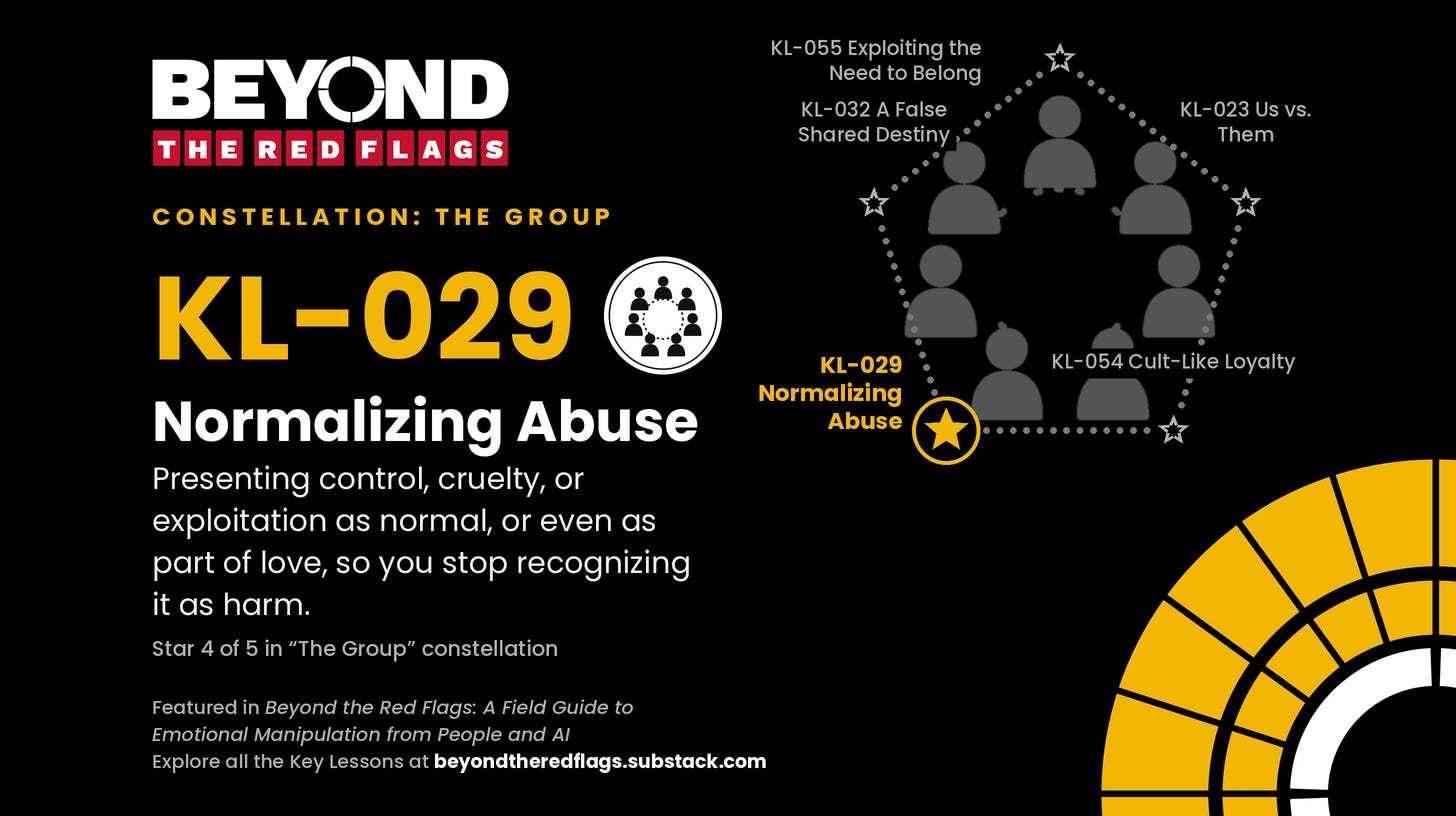
Start here to learn about Normalizing Abuse (KL-029), one of the Beyond the Red Flags Key Lessons.
From the book Beyond the Red Flags: A Field Guide to Emotional Manipulation from People and AI:
What Normalizing Abuse is: Presenting control, cruelty, or exploitation as normal, or even as part of love, so you stop recognizing it as harm.
Normalizing Abuse in the Lexicon: Normalizing abuse involves presenting harmful behavior as normal, acceptable, or expression of love. "All couples fight like this," "this is just how relationships work," "I only hit you because I love you" reframe abuse as normal.
Terms related to Normalizing Abuse: Gaslighting · Love justifies harm · Promises of love to justify harm

A lot of people think abuse is easy to spot—loud yelling, physical violence, or bruises. But the truth is, many survivors didn’t recognize the warning signs until it was too late.
Let’s break this down in a way anyone can understand. Imagine someone gives you a cookie every day and tells you how special you are. After a while, they say you owe them for all those cookies. You didn’t ask for anything—but now you feel trapped. That’s how emotional manipulation works.
This post is about going beyond the red flags. It’s about why people stay in unhealthy relationships and how we can build safer, healthier connections instead.
⚠️ And just to be clear: this is only ONE way abuse can look. Abuse can take many forms—physical, digital, financial, sexual, spiritual—and it doesn’t always come from romantic partners. This is just one example to help explain the complexity.

The Subtle Start of Emotional Manipulation
Abuse prevention often starts by teaching people that abuse doesn’t always feel bad at first. It can look like love, protection, or support. That’s what makes it so dangerous—and why recognizing grooming signs is so important.
In abusive relationships, control builds over time. Survivors often feel:
Confused by how quickly things escalated
Guilty for wanting to leave
Isolated from support systems
Afraid of what might happen if they speak up
These are all part of how trauma bonding can take hold—where the fear, guilt, and moments of care get twisted together.
Relationship Red Flags: Watch out for this
🚩 Moving too fast—saying “I love you” or pushing for commitment early on
🚩 Making you feel guilty for needing space or time away
🚩 Giving gifts or money and expecting something in return
🚩 Cutting you off from friends or family
🚩 Blaming you for their bad behavior
🚩 Creating a cycle of highs and lows that keep you emotionally off-balance
These are early relationship red flags. They’re often overlooked because they don’t feel dangerous right away—but they are signs of control.
Healthy Relationships: What should happen
✅ Healthy relationships move at a pace that feels right for both people
✅ Boundaries are respected, even when they’re inconvenient
✅ Support doesn’t come with strings attached
✅ You’re encouraged to maintain your independence and outside support
✅ Apologies are backed by real change—not just empty promises
✅ You feel consistently safe, seen, and respected
This is what safe relationship tips are all about—building habits that empower, rather than control.
Real-Life Analogy:
Picture being invited on a road trip with someone you trust. At first, it’s fun. They play your favorite music and make you feel special. But then they stop letting you pick the stops. They say, “You wouldn’t survive out here without me.” Now you’re far from home and unsure how to leave.
That’s what emotional manipulation can feel like. You didn’t ask to go this far—but now you don’t know how to get out.
Abuse Prevention Starts with Empowerment Education
To stop abuse before it escalates, we need more than just lists of red flags. We need to teach what real love and safety look like. That’s why empowerment education—especially through experiences like TRAPPED: A VR Detective Story—is so powerful. It helps people see how small choices and manipulation can lead to much bigger dangers.
And again, we want to stress: ⚠️ This is just one kind of abuse.
Someone might experience digital abuse, spiritual abuse, or financial control without a single raised voice. That’s why education, awareness, and compassion are key.
Normalizing Abuse in TRAPPED
In TRAPPED: A VR Detective Story, Lisa’s story shows normalizing abuse in these moments:
The lipstick (the apartment): “This is Lumpy’s favorite color. He says it ‘makes me look 18,’ which makes men think I want to be paid to have sex for some reason. I hate it, but I have to help Lumpy make money if we are ever going to move away together. He says he almost has enough, so I am going to try harder.”
The food (the apartment): “I washed these so you couldn’t see any streaks or spots on them. I hope Lumpy notices, because it’s my birthday and I wanted him to smile for me.”
The food (the apartment): “Lumpy doesn’t seem to care, but I always try to make the table nicely for him. I want him to be happy.”
The phone (the apartment): “I have to use this to advertise myself online and find Johns. I’ll create some new online ads later tonight so I can make enough money to keep Lumpy happy.”
The phone (the apartment): “Lumpy tells me what to do when he texts me. He takes me to my dates and I have to tell him when I am finished. He likes it when I call him Daddy, so that’s his name on the phone.”
The computer (her childhood bedroom): “Lumpy was the first older boy to care about me. I know it’s hard for others to understand, but despite everything he’s done, I still love him.”
The kitchen window (the apartment): “At least I have a way to see outside. Some girls I know aren’t even that lucky. The only time they get outside is to go on a date or if their pimp has to take them to do something, like go to a doctor.”
The kitchen window (the apartment): “At least I have a way to see out. Some girls aren’t even that lucky.”
The condoms (the apartment): “I never learned much about birth control or sexually transmitted diseases, to be honest. Lumpy says he’s taking care of everything, so everything must be okay or he’d take me to a doctor.”
The phone messages (the apartment): “My dates have been getting more and more violent. I’m glad that Lumpy takes me to my dates, but he’s not in the room with me. I call him Daddy on the phone so people don’t recognize his name.”
Step into Lisa’s story → TRAPPED: A VR Detective Story
Key Lessons in this post: KL-029 Normalizing Abuse · KL-050 Gradual Escalation · KL-018 Love Bombing
Normalizing Abuse (KL-029) is featured in Beyond the Red Flags: A Field Guide to Emotional Manipulation from People and AI. Get the book →
Where to next?
Your ship is fueled and the stars are out. Pick a destination.
The Field Guide: our book, Beyond the Red Flags: A Field Guide to Emotional Manipulation from People and AI. Ask for your copy.
The Key Lessons: chart the whole sky. Every lesson in its constellation, with its definition from the book.
TRAPPED: A VR Detective Story: step inside the case.
Free wallpapers and banners: put the stars on your phone and your profiles.
About Radical Empathy Education Foundation
We prevent abuse through interactive education, including VR. We built what we wish had existed for us and our children. Our flagship program, TRAPPED: A VR Detective Story, has trained over 20,000 people across America. It teaches the Beyond the Red Flags Key Lessons drawn from what 109 organizations and authors in the field actually teach, mapped to interactive dialogue, and deliverable in a single class period.
Nobody understands until they put on the headset. The immersion and privacy change everything. That’s why 98.6% of respondents at the 2018 TASC conference wanted it in their schools — and why we don’t send brochures. We send headsets.
Jacqueline Cain, Co-Founder jacqueline@reefcares.org · 512.545.0525
Billy Joe Cain, Co-Founder billy@reefcares.org · 512.521.8874
reefcares.org · Schedule a demo
☕ Buy us a coffee · 💛 Donate via PayPal
501(c)(3) · EIN 82-0704070 · Verify on GuideStar · All donations are tax-deductible.
TRAPPED: A VR Detective Story is developed by differentOctober and licensed to Radical Empathy Education Foundation.
© Billy Joe Cain and Jacqueline Cain (differentOctober). Used by reefcares.org with permission.
Subscribe free — every subscriber helps more people find us.
Learn more about Radical Empathy Education Foundation and connect to access their VR training at ArborXR’s XR Directory.
Yes! People don't seem to understand if I punch you on the first date, I'm probably not getting a second date. I'm going to start out incredibly charming, the jealousy at first seems romantic, then it's just small insults and verbal abuse...by the time I'm becoming openly abusive, I've already sucked you in and made it incredibly difficult to get away from me.