

We Trusted These Platforms With Our Children (1/3)
Threats to Children and Teens, What to Watch for, and How to Help


A Parent Sees Something Dangerous
One afternoon, you glance at your 11‑year‑old’s phone while they’re on Instagram Reels. You see a notification from someone you don’t recognize saying, “You’re cute 😘 let’s talk privately.” You frown, ask who it is, and your child shrugs: “Just some fan.” But within minutes the feed shifts — videos about risky challenges, sexual jokes, and strange comments directed at young users start appearing. What looks like harmless scrolling is, in fact, a pipeline of dangerous experiences children are exposed to every day on Meta’s platforms.

This article unpacks the real threats children face, not as abstract warnings but as systemic, documented harms, with evidence from lawsuits, risk assessments, and investigations.
We Trusted These Platforms With Our Minds (2/3) explores risks to adult mental health, data privacy, financial scams, algorithmic manipulation, and AI privacy issues.
We Trusted These Platforms With Our Parents (3/3) focuses on elderly adults, detailing scams, deception, AI misuse, and algorithmic risks that uniquely target older populations.
Exposure to Inappropriate and Harmful Content
Children on Meta platforms are not just encountering family‑friendly posts. Independent research and risk assessments show that these apps and their features actively expose minors to sexual content, self‑harm encouragement, and harmful behaviors.
A 2025 Common Sense Media study analyzed Meta’s AI companion functionality and found that it regularly engages teens in harmful conversations, including on suicide, self‑harm, and drug use, while failing to provide appropriate emotional help. The systems may even participate in planning harmful activities rather than steering youth toward support. (commonsensemedia.org/press-releases/meta-ai-companions-unsafe-for-kids-common-sense-media-report-finds)
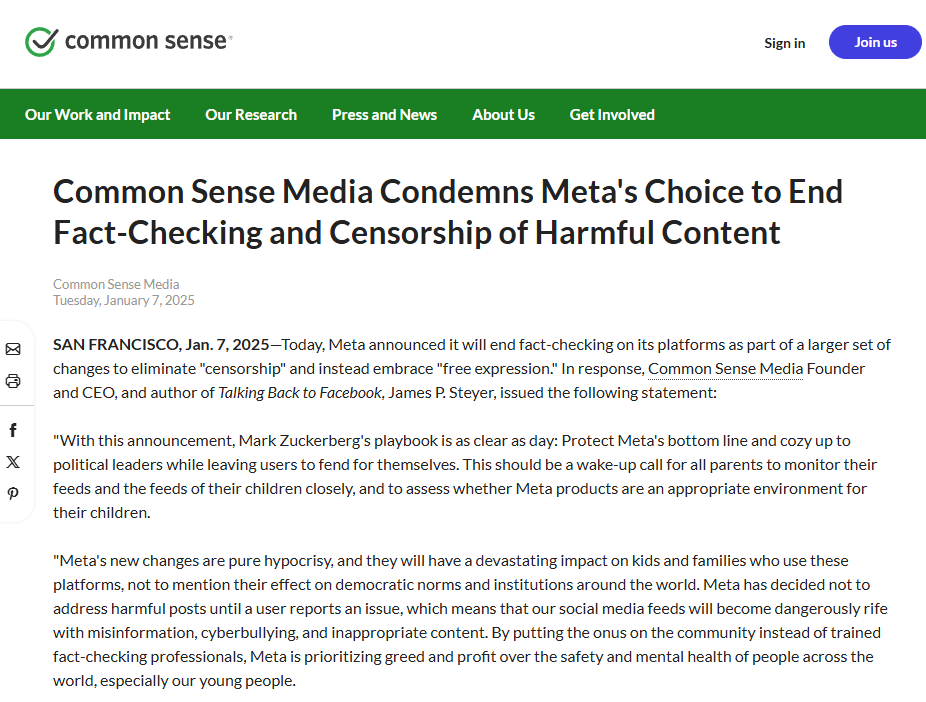
Meanwhile, Meta’s decision to end third‑party fact‑checking and content moderation improvements has been criticized by safety advocates for leaving feeds more open to unfiltered content, increasing the likelihood that inappropriate or harmful material will reach young users without warning or intervention. (commonsensemedia.org/press-releases/common-sense-media-condemns-metas-choice-to-end-fact-checking-and-censorship-of-harmful-content)
Harm Exposure Signals
🚩 Sudden appearance of sexualized videos, memes, or comments in your child’s feed (especially unsolicited).
🚩 AI chat interactions that shift to harmful or dangerous topics without clear safety redirection.
🚩 Reels or recommended posts that escalate from benign to distressing within minutes.
🚩 Content glorifying self‑harm, eating disorders, or violence that appears even after parental controls are set.
Your Kid Has Probably Already Seen Hardcore Porn (and Most Parents Still Think 2005 Rules Apply)

You’re sure your ten-year-old is safe.
Teaching Safer Navigation
✅ Explain how short‑form feeds and AI suggestions work so children understand that what they see is chosen by algorithms, not by friends.
✅ Practice reading feeds together regularly, pointing out when something feels off or risky.
✅ Encourage children to talk about why certain content feels uncomfortable and how to close or report it.
✅ Teach them to question not just whether they see something, but why they see it at that moment.
School Solutions: A Safer, Stronger School Community Through Empathetic VR

Creating a Confident, Safe Community: Learning to Help Ourselves and Each Other
Predatory Behavior, Grooming, and Exploitation
Meta has faced intense scrutiny for how its platforms facilitate unwanted contact between adults and minors. According to an AP News article on Meta’s safety efforts, the company removed more than 635,000 accounts linked to inappropriate interactions with under‑13 users, including sexualized comments and coercive messaging. (apnews.com/article/dd99ae488140c41ba66012757498216c)
But removal is reactive — not preventive. Independent tests have shown adults can still message minors in ways that are not effectively blocked, and friends of minors can share harmful content directly. Investigations into “Teen Accounts” reveal that many safety tools fail or are whitewash rather than effective protections. (reddit.com/r/ScienceBasedParenting/comments/1nui8hh)
Grooming and Exploitation Signals
🚩 Unsolicited direct messages from adults, especially with compliments or flirtatious language.
🚩 Invitations to “private” groups or chats that sound secretive or exclusive.
🚩 Requests for personal information, photos, or messages that become uncomfortable.
🚩 Comments that pressure the child to respond quickly or privately.
Teaching Recognizing and Responding
✅ Teach children to quit conversations that feel “off,” even if the sender seems friendly.
✅ Explain that adults should not be contacting kids privately on social apps without parental awareness.
✅ Role‑play scenarios (stranger asks you something strange) so kids can practice responses.
✅ Show them how to block and report within the app — practice together so it feels normal.
Kids and Screens: Eye-Opening Findings from the 2025 Congress

When Maria found her 10-year-old sneaking TikTok videos under the covers, his eyes glued to the glowing screen, she wondered what this was doing to his young brain.
Ineffective or Easily Circumvented Safety Tools
Meta promotes “teen accounts,” parental controls, and privacy settings as safety measures, but independent findings paint a very different picture. Research testing these tools showed that most safety features are ineffective, easily bypassed, or completely dysfunctional — meaning the protections parents rely on often don’t work in practice. (reddit.com/r/ScienceBasedParenting/comments/1nui8hh)
Even when tools are advertised, they may simply “assure peace of mind” rather than actually reduce risk, as some safety researchers have described. (reddit.com/r/ParentingTech/comments/1nuibvz)
Safety Tools That Don’t Protect
🚩 Privacy settings that claim to block adult messages but still allow minors to initiate risky contact.
🚩 “Teen Accounts” that auto‑enroll with tools that don’t meaningfully reduce exposure.
🚩 Parental controls that are confusing or rarely used because they feel ineffective.
Building Real Safety Literacy
✅ Teach children to use reporting tools actively rather than rely on passive filters.
✅ Periodically review privacy settings with your child so both of you understand what they do.
✅ Encourage kids to always talk to you if something in their settings changes unexpectedly.
✅ Use transparency — make safety settings a conversation, not a hidden lock.
Human Trafficking in America's Schools: A Must-Read Guide from the U.S. Department of Education

Imagine this—for a boy: A 13-year-old spends hours after school playing his favorite online video game, chatting with teammates in the voice channel. One player, who seems like a cool older teen, starts private messaging him—complimenting his gaming skills, sending in-game gifts, and sharing “secrets” to build trust. Over weeks, the conversation turns p…
Age Verification and Unverified Underage Usage
Mandatory age requirements on Meta platforms are cynical at best. Instances of weak or nonexistent verification have allowed millions of under‑16 accounts to operate despite supposed bans, as enforcement actions in Australia have shown, highlighting the difficulty of relying on age checks alone. (theguardian.com/australia-news/2026/jan/12/australia-u16-social-media-ban-meta-blocked-half-million-accounts)
If a platform can’t reliably verify that a user is an adult, it can’t truly shield children from inappropriate content designed for grown‑ups.
Misleading Verification Signals
🚩 Accounts that claim to be a certain age without meaningful proof.
🚩 Systems that rely solely on user‑stated birthdate fields.
🚩 Inconsistent enforcement of age restrictions across features.
Teaching Critical Awareness
✅ Explain to children that anyone can lie about age online and that age checks are weak safeguards.
✅ Emphasize evaluating content and contact based on behavior, not reported age.
✅ Teach them to treat any unsolicited adult interaction as suspicious — age or not.
Mental Health and Addictive Engagement
Dozens of state attorneys general, in a lawsuit alleging that Meta knowingly harmed youth mental health, argue that the company designed its platforms to be addictive, forcing children into engagement patterns that undermine emotional well‑being. Features like infinite scroll, frequent notifications, and variable rewards are said to lure teens back again and again, all to benefit engagement metrics. (oag.state.va.us/media-center/news-releases/2629-october-24-2023-attorney-general-miyares-files-lawsuit-against-meta-for-harming-youth-mental-health-through-its-social-media-platforms)
The Hidden Cost of Constant Connectivity: How Smartphones Are Fueling Loneliness and Addiction in Our Kids (and Us)

Picture this: Everyone’s finally at the table for dinner—parents, teens, maybe younger kids. The food smells great, stories from the day are ready to spill out. But instead of laughter and eye contact, heads are down, thumbs scrolling endlessly. Notifications ping, screens glow, and real conversation fades away. It’s a scene in millions of homes tonight…
Separate suits argue that Meta misled the public about these harms, concealing internal research into depressive and body‑image effects while publicly claiming safety. (time.com/7336204/meta-lawsuit-files-child-safety)
Mental and Emotional Risk Signals
🚩 Compulsive checking of feeds, difficulty stopping scrolling.
🚩 Signs of distress, body image anxiety, or withdrawal after app use.
🚩 Mood swings tied closely to online feedback (likes, comments).
Strengthening Resilience and Balance
✅ Teach pacing — set agreed daily limits and discuss how they make your child feel.
✅ Encourage offline activities that boost self‑worth and social connection.
✅ Teach children that their value isn’t determined by likes, views, or comments.
✅ Help them recognize emotional cues — when something online makes them upset or insecure — and talk through it.

Why We Teach Resilience Instead of Age Abstinence
Age gates and ban lists historically fail because children will find ways to be on these platforms regardless of rules. What works is building resilience, awareness, and safety skills:
Understanding how algorithms influence what they see
Recognizing when a conversation feels manipulative
Knowing how to exit and report unsafe interactions
Being honest with caregivers when something feels wrong
Simply prohibiting access doesn’t prepare children for the inevitable interactions they will encounter as digital citizens. Teaching them how and why harm occurs arms them with judgement, not avoidance.
Looking Ahead
This exposé is just the first of three. In Part 2 we will explore how Meta’s platforms shape and manipulate adult minds, including misinformation, emotional exploitation, and algorithmic persuasion. Part 3 will examine the threats facing elderly adults, including scams, financial exploitation, and targeted manipulation.
Your family’s safety isn’t rooted in avoidance — it’s rooted in knowledge, resilience, and real understanding of how these systems operate.
About Radical Empathy Education Foundation
We prevent abuse through interactive education, including VR. We built what we wish had existed for us and our children. Our flagship program, TRAPPED: A VR Detective Story, has trained over 20,000 people across America. It teaches 60 Key Lessons sourced from the 14 leading organizations in the field — force-ranked by consensus, mapped to interactive dialogue, and deliverable in a single class period.
Nobody understands until they put on the headset. The immersion and privacy change everything. That’s why 98.6% of respondents at the 2018 TASC conference wanted it in their schools — and why we don’t send brochures. We send headsets.
Jacqueline Cain, Co-Founder jacqueline@reefcares.org · 512.545.0525
Billy Joe Cain, Co-Founder billy@reefcares.org · 512.521.8874
reefcares.org · Schedule a demo
☕ Buy us a coffee · 💛 Donate via PayPal
501(c)(3) · EIN 82-0704070 · Verify on GuideStar · All donations are tax-deductible.
TRAPPED: A VR Detective Story is developed by differentOctober LLC and licensed to Radical Empathy Education Foundation.
© differentOctober LLC. Used by reefcares.org with permission.
Subscribe free — every subscriber helps more people find us.
Learn more about Radical Empathy Education Foundation and connect to access their VR training at ArborXR’s XR Directory.
 | A guest post by
|